Enhancing Evaluation Integrity Through On-Screen Marking
When the final bell rings and answer sheets are collected, it feels like the examination has ended. But for examination authorities, that is only the halfway point.
Every answer script now enters a process that determines admissions, scholarships, government jobs, promotions, and ultimately, the future of millions of candidates. While considerable attention is given to conducting secure examinations, the evaluation stage often receives far less attention despite carrying equally significant consequences.
After all, an examination can be conducted flawlessly, but if evaluation lacks consistency, transparency or efficiency, the credibility of the entire process comes into question.
The Hidden Challenge
Evaluation today involves far more than assigning marks. Large examination bodies must ensure that thousands of evaluators apply marking schemes consistently while working within strict timelines. Fatigue, manual handling, illegible handwriting, missing pages, arithmetic errors and inconsistent interpretation can all introduce avoidable risks.
As candidate volumes continue to grow, these challenges become increasingly difficult to manage using conventional paper-based processes.
Rethinking Evaluation
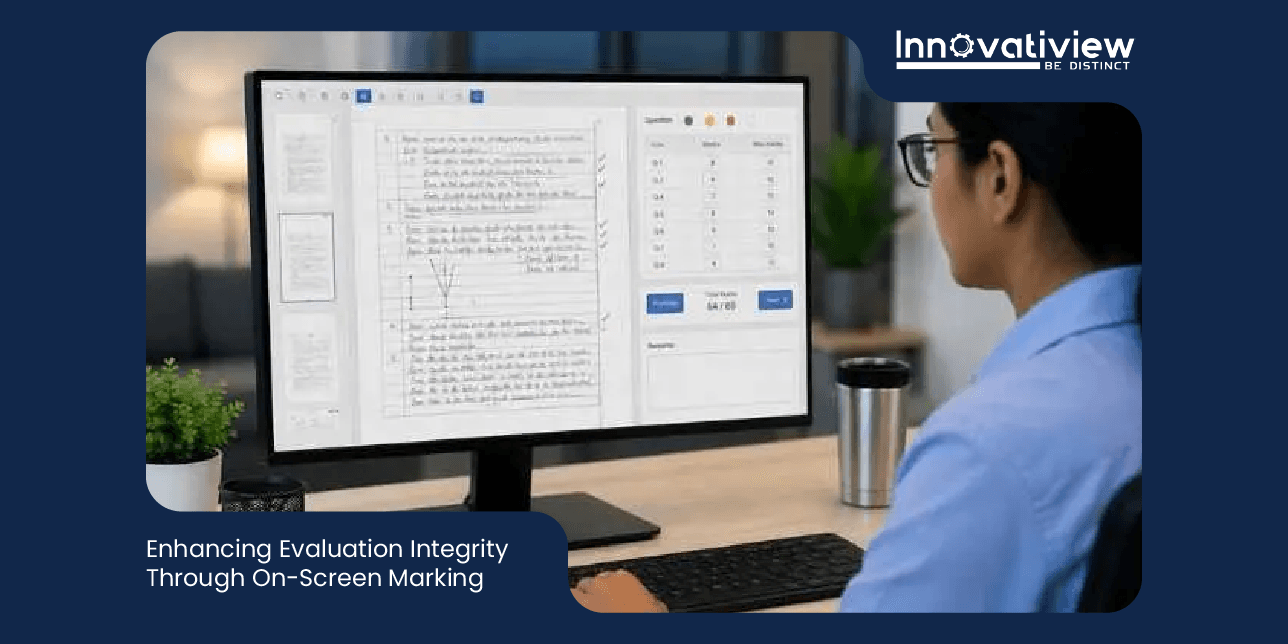
Digital On-Screen Marking transforms evaluation into a structured, standardised and auditable workflow.
Instead of transporting physical answer sheets between locations, scanned scripts are securely distributed to authorised evaluators through a centralised platform.
The system helps examination authorities maintain consistency by enabling:
· Question-wise evaluation
· Digital moderation workflows
· Role-based access controls
· Automated mark compilation
· Comprehensive audit trails
· Real-time monitoring of evaluation progress
The objective is not to replace human judgement, but to support it with technology that improves fairness, efficiency and accountability.
Fairness Through Standardisation
Candidates expect more than accurate marks—they expect confidence that every answer has been evaluated using the same standards.
Digital evaluation introduces greater transparency into a process that has traditionally depended on manual controls. Every action can be tracked, reviewed and validated, strengthening trust in the final result.
Beyond efficiency, digital evaluation also generates valuable insights that were previously difficult to capture. Examination authorities can monitor evaluator performance, identify scoring variations, analyse turnaround times, and ensure moderation is carried out systematically. These data-driven insights not only improve the quality of the current evaluation cycle but also help refine future examination processes, making the entire assessment ecosystem more transparent, accountable, and resilient.
Looking Ahead
As examinations become larger and more competitive, the focus is shifting beyond secure test administration to secure and transparent evaluation. Because examination integrity doesn’t end when candidates leave the examination hall. It ends only when every answer has been evaluated fairly, consistently and transparently.